
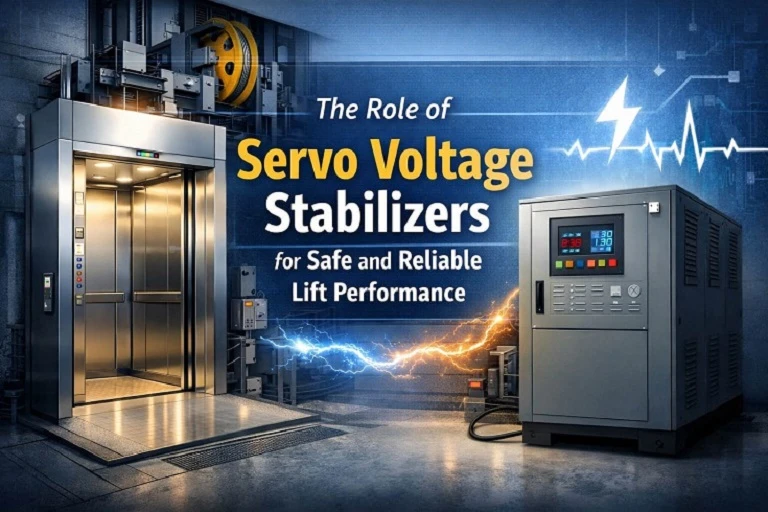
Modern lifts are precision-driven systems, where uninterrupted power is crucial for smooth, silent, and safe operation. A single power fluctuation can trigger sudden halts, damage control panels, or reduce the lifespan of vital components. In many industries, voltage instabilities reduce maintenance costs and interrupt daily operations. The servo voltage stabilizer is reliable because it provides steady power even under severe voltage shocks. It protects lift systems from surges, dips, and overloads, ensuring a stable performance, improved reliability, and long-term operational confidence, unlike traditional stabilizers.
A reliable power supply enables lifts to move safely, smoothly, and without any unexpected risks.
Passenger Entrapment Prevention
Sudden lift stoppage or system reset can be caused by voltage sags or surges, which leave the passengers trapped between floors. Although these are constructed to ensure safety, they may be uncomfortable and unsafe for elderly passengers or those with medical conditions, which has a direct impact on lift safety.
Safety System Reliability
Emergency brakes, door sensors and overload protection systems rely on constant electrical signals. Their smooth operation could be disrupted by an unstable power supply, which would decrease the accuracy of their responses and undermine enhanced safety.
Smooth Motor Control
Lift motors operate efficiently at a fixed voltage, providing the optimal amount of torque. Voltage instability may lead to jittery motion, improper floor leveling, or overheating of the motor, resulting in higher mechanical wear and a risk to passengers.
Electronics Protection
New elevator systems depend on high-tech controllers, VFDs and microprocessors. A power spike or electrical noise can damage this sensitive electrical equipment. It causes unpredictable malfunctions or complete failure of the entire system.
Emergency Power Readiness
Backup facilities, such as emergency rescue devices and alarms, should be activated immediately during outages. Constant voltage can be switched to emergency power without interruption, ensuring passenger safety.
The details are:
1. Unexpected Stops
Sudden power fluctuations can cause lifts to stop mid-travel, often triggering safety systems to prevent damage. In buildings where lifts and escalators share power lines, these interruptions are even more noticeable. This makes passengers wait unexpectedly. Cabin Trapping Risks
Passengers may become trapped between floors due to voltage problems. Consistent lift operation is essential because even brief delays can lead to stress, anxiety, or panic, particularly for elderly or sick passengers.
2. Sensor Problems
Door sensors, load detectors, and floor-position indicators can all become confused by fluctuating voltage. Call buttons may respond slowly, and doors may open late or slightly out of alignment; appropriate solutions for voltage drop in industrial systems frequently resolve these issues.
3. Wear of Equipment
The high frequency of power variations places a strain on motors, wiring, and control panels. Over the long term, this results in overheating, insulation damage and circuit breaker trips. This increases maintenance expenses.
A stabilizer guarantees smooth operation. It helps with:
Monitoring: The stabilizer continuously records the grid voltage to detect any irregularities that may affect the electrical equipment in the lift system.
Detection: It compares the incoming voltage with the desired standard of 415V for 3-phase lifts, allowing it to detect deviations and take corrective action.
Correction: When the voltage is too high or too low, the stabilizer immediately corrects it.
Overvoltage: This stabilizer bucks too much voltage using electronic or electromagnetic components.
Undervoltage: It boosts low voltage to keep the lift running smoothly. This step demonstrates the power of a voltage stabilizer in providing stable energy to critical components.
Output: The lift motor and control panel are maintained at a constant voltage, ensuring continuous operation even in grid conditions.
Protection: If the voltage exceeds the safe level, the stabilizer can completely shut off power for safety reasons. Integration with isolation transformers for safe electricity use provides an additional layer of security to protect passengers and lift systems.
A consistent power supply ensures smooth elevator operation, protects equipment, and enhances passenger safety. This reduces energy waste, lowers operational costs, and ensures the elevator remains reliable for a longer period.
1. Fast Correction
The stabilizer features a lightning-fast response time of 50 microseconds and a regulation speed of 4,000 volts/sec. This aspect allows the stabilizer to correct fluctuations instantly. Thus, it ensures continuous operation and enhances passenger safety.
2. Stable Output
It provides a constant output voltage, eliminating the sudden stops or jerks. This ensures that delicate electrical components in lift control systems are protected from damage.
3. Surge Protection
The stabilizer protects the elevators against spikes, surges, and electrical noise, delivering clean power that ensures motors and control circuits remain reliable and fully functional.
4. Phase Management
It supports unbalanced 3-phase inputs, providing extensive protection against over-voltage, under voltage, phase reversal, single phasing, overload, over temperature, and short circuits, as well as advanced phase correction. This makes it one of the most effective solutions for voltage drop in industrial systems.
You should ensure that stabilizer’s output (KVA) is equivalent to the load on the elevator motor. Sum up the overall loads, including power factor, and add 25-30 percent as an enhanced safety margin. Select a three-phase unit for most industrial lifts to compensate for unbalanced loads. It is recommended to use a wide input voltage range, e.g., 340–480V, for accurate correction and a constant output of approximately 400V, with a tolerance of 1%. Fast response, copper winding, digital displays, and safety functions such as over-voltage and short-circuit protection are recommended to ensure the reliability and long-term use of electrical equipment.
Conclusion
Voltage stabilizers are a crucial component of modern power systems, ensuring the protection of equipment, enhancing energy efficiency, and facilitating smooth operation. With proper selection and maintenance, performance and durability are greatly improved. Lift safety is also guaranteed for the passengers.