
Voltage instability is a key issue across a wide range of industrial settings, particularly in those involving fragile equipment and ongoing processes. Even a small variation can disrupt processes, damage machinery, or reduce production quality. This is where servo stabilizers play a crucial role.
These systems provide a constant, regulated supply of voltage, helping ensure that various industries remain safe, efficient, and reliable in their operations. The units developed today by a reputable manufacturer of servo voltage stabilizers are designed to meet the high-demand requirements of various industries and support both small and large facilities.
Stabilizers of various types include automation systems tailored to load requirements and operating conditions.
> Single-Phase Servo Stabilizer: This is best suited for laboratories, offices, and other small machinery that require tight regulation.
> Three-Phase Air-Cooled Servo Stabilizer: This is used in manufacturing plants, textile, and other factories with moderate loads.
> Three-Phase Oil-Cooled Servo Stabilizer: It is ideal for continuous or heavy-duty work, and even for high ambient temperatures.
> Unbalanced Load Servo Stabilizer: It is used in facilities with an uneven load distribution among the phases.
> Balanced Load Servo Stabilizer: Ideal for equipment with equal-phase load requirements.
> Linear Type / Roller Type / Dimmer-Based Designs: Applied depending on the required precision, load type, and system complexity.
Servo stabilizers are important in various fields, as they provide stable voltage, equipment security, and uninterrupted, consistent performance in harsh working conditions.
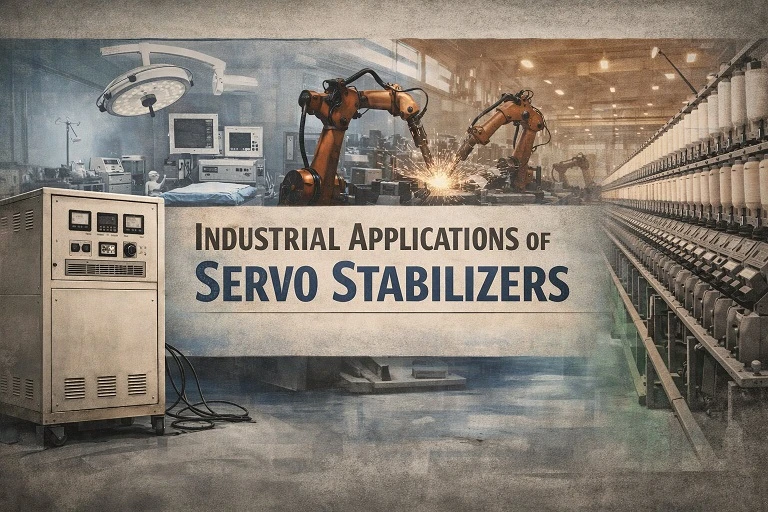
Servo stabilizers play an important role in hospitals and diagnostic centers, where machines such as MRI scanners, CT scanners, dialysis units, ultrasound systems, and laboratory analyzers require a constant voltage supply. They eliminate failures, inaccurate results, and losses due to unexpected variations in expensive medical equipment.
Servo stabilizers are used in manufacturing plants to support CNC machines, motors, robot arms, conveyor lines, and automation lines. The machines require a constant, accurate voltage to operate reliably, prevent failures, and continue production cycles.
The textile industry depends on stabilizers to ensure the smooth operation of spinning machines, weaving mules, knitting machines, and dye baths. Correct voltage control ensures consistent output quality.
The printing presses, packaging machines, servers, and fast-digital machines will require constant voltage to remain accurate and prevent unnecessary, expensive mistakes. Servo stabilizers protect control panels, computing equipment, and electronic circuits against voltage spikes and dips.
Stable voltage helps to keep commercial buildings and elevators safe, minimize failures, and increase equipment life. A dedicated servo voltage stabilizer for lift safety ensures elevators operate smoothly even when the grid supply fluctuates.
Constant-voltage systems significantly improve energy efficiency in industry, and servo stabilizers help achieve this goal in several ways.
> They provide the machines with the specific voltage they require without overheating.
> Constant correction minimizes the voltage difference.
> Motors, pumps, and compressors operate at optimal efficiency, helping industries save on electricity bills.
> Reduced load stress will remove heat, retain parts, and extend equipment service life, reducing maintenance needs.
> By this, they save the energy wasted during restarts or during idle time caused by breakdowns.
Selecting the optimal stabilizer is based on several operational and technical variables. The initial step is to determine the facility's overall loading capacity. The total rating of all equipment in the industry should be calculated, and the stabilizer should withstand peak loads without undue strain.
The input voltage range for the location should also be considered. Areas with frequent low- or high-voltage fluctuations require stabilizers with a broader correction range to maintain consistent operation. The type of equipment under protection also determines the choice. Delicate electronics require higher correction speed and greater output accuracy. Major industrial machines require stabilizers with powerful cooling systems and stronger transformers. Space availability, humidity, temperature, dust, and other environmental conditions also contribute to the choice of model.
Sales support, service availability, and installation skills also contribute to long-term performance. Collaboration with an established servo voltage stabilizer manufacturer ensures adequate evaluation, load testing, and configuration tailored to industry-specific operational needs.
Additional features such as remote monitoring, digital meters, alarms, and safety protections are common in many industries nowadays.
Conclusion
The use of servo stabilizers has been important in industries that require stable voltage and continuous operation. They safeguard delicate equipment, minimize operational downtimes, and contribute to the failure-free quality of production in the healthcare, manufacturing, textile, automation, and commercial segments. The appropriate model choice will guarantee improved energy efficiency, extended equipment lifespan, and reduced operational risk. Thanks to the high functionality and professional advice of a reputable manufacturer, industries will achieve stable long-term voltage and a smoother overall labor process.